AMDEES®
Digital Medical Data Preserving & Online Reporting Company
To
E-Health Division
Department of Health & Family Welfare
Ministry of Health & Family Welfare
Government of India
AMDEES is sharing a path of Electronic Health Records viability in India. Expressing foundational parameters based on the company’s research, experiments, and results along with observation of national healthcare workflow, structure & culture.
Company
Ambition: Billion Organized Health
Healthcare digitalization is a historic turning point in modernizing the Indian medical system that will transform India’s health perspective. This priceless initiative will increase providers’ quality caring efficiency, précised effective transparent care to patients & boundless empowerment for the Government in remedial sector management, and more. Young India’s much-needed health prioritization will add value to the progressive nation that is roaring on a global platform.
About Company
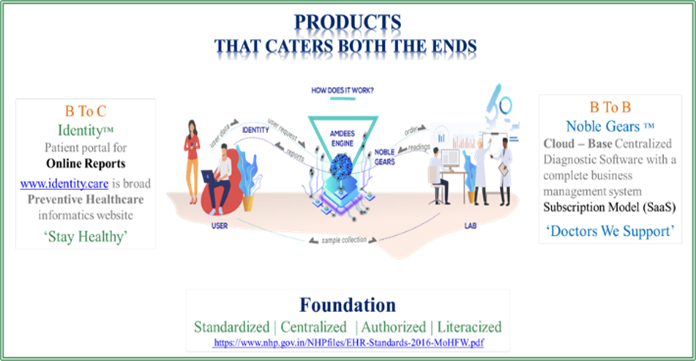
We provide digitalized medical data preserving & delivery conceptual services to Healthcare Diagnostic Laboratories. The concept involves Standard-Centralized cloud-based Software and server, Machine Interfacing, Reporting Portals (web/App), and Universal Updates – Logical Upgrades that promote systematic practice and uniform execution of diagnostic outcomes.
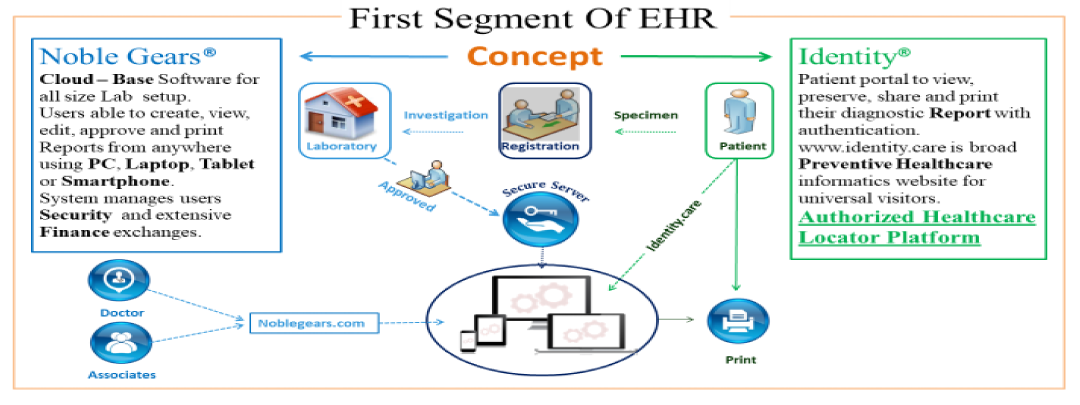
This system is built in collaboration with medical proficiency & IT intelligence under a single roof with the company’s intellectual properties, initiative of applying LOINC - HL7 guidelines, and fieldwork research to enrol in the first phase of EHR.
At present our programs benefit all participating entities that run in 45 Labs, engaged Clinics and hospitals, registered 2.5 million Patients, and accumulated 8 million diagnostic reports on a centralized secure server that can be accessed by authorized users, wherever required.
Our extended program is to facilitate authorized nationwide Labs in a 3–5-mile radius that can be connected with their surrounding healthcare services for uniformed caregiving link to Citizens, geographically.
Accomplished:
- Successful implementation of Standard Report Formats across the clients with LOINC initiative and used HL7 guideline for diagnostic workflow application
- Centralized updating for uniformity and server facilitation for data storing, sharing & delivery
- A Paperless Healthcare Ecosystem, Application No: 1506/MUM/2013 A - WO/2014/178077
- 2. An Electronic Modular and Customizable Pathology Test Form Creation System. Application No: 3126/MUM/2013 A – WO/2015/049699
Next: Radiology- OPD – IPD (HMS) – Pharmacy – Others, links EHR concept
Subject Overview
EHR
The digital system is built to go beyond standard clinical data collected in a provider’s office and can be inclusive of a broader view of a patient’s care. The platform Includes information on patient demographics, progress notes, diagnostic images & reports, medications, problems, allergies, vital signs, past medical history, family health history, immunizations, etc.
EHR & EMR
Electronic Health Records (EHR) is a nationally recognized interoperability standard that can be created, managed and consulted by authorized clinicians, and staff across more than one healthcare organization.
Electronic Medical Records (EMR) is limited to a specific institution or a group of institutions
EHR Significance
Personal medical history can play a central role in evaluating patients in a variety of medical settings, particularly in emergencies. Effortless access to the medical history of the patient helps the doctor to provide more efficient, accurate, and appropriate care without wasting any time. Having current personal medical records can be even more important for people who are unable to provide their medical history adequately, such as unconscious, illiterates, children, and the elderly.
EHR Global
Over two decades, around 40 countries established electronic patient records in their national network infrastructures. Countries are taking an interest in public health because the governments are Medicare provider themselves and require transparency to control their funds. Other areas of EHR implementation are financial stabilities, literacy, awareness, population (minuscule), and advancement.
Tested Examples
- Canada launched an initiative in 2001 to modernize its ICT infrastructure in healthcare. EHRs were created for 91% of Canadians, and 91,000 clinicians were using EHR systems in their work.
- In 2001, England started a national initiative called the "National Plan for IT" (NPfIT) to modernize its healthcare system. Under the initiative, Summary Health Records (SHRs) were created for 54 million persons (96% of the population).
- In Germany, about 90% of physicians in private practice are using EHR systems. Patient privacy has been given adequate attention in the initiative. The patient can decide to hide or block any entry in the health record.
- New Zealand has achieved an EHR adoption rate of 97%. At present, there is no central or single EHR system, but a distributed EHR system, which can be accessed from any entity across the nation. The country is aiming to have a single EHR system.
- The United States has been working on the adoption of EHR for quite some time. The federal government is providing financial incentives to those who make 'meaningful use' of EHR. The incentive is given through the Office of National Coordinator (ONC) for Health Information Technology to those who have started using EMRs. According to the data available, 76% of hospitals have adopted basic EHR systems. It has been reported that 97% of acute care hospitals have adopted certified EHR systems.
EHR Functional country
Indian Healthcare Scenario
Practice
- Number of Patients against short falling Healthcare
- Lack of skilled manpower for healthcare support
- Weak infrastructure despite everything available/possible
- Unstructured reporting
- Standard terminology absence
- Negligent care and serious lack of transparency with the patient
- Unethical and unnecessary procedures
- Under qualified setups
Traditional (Paper) – Most
Critical health documents are mostly paper-based which is not just inefficient but extremely vulnerable to error and practically impossible to manage. It can place Patient safety and quality of life at risk when the details of diagnosis or treatment history are lost, destroyed, overlooked, or can’t be retrieved in a timely manner.
Digitalized – Few
Healthcare software suppliers with various terminology platforms, supply systems to private entities with custom-made demands without any specific regulation for more than a decade. Result; They have created tailor-made healthcare Islands that don’t have common data exchange functions.
Government Establishments
State-run facilities are used by a large portion of the underprivileged population, always overcrowded, so updating is essential. Need extensive initiative to revamp an entire system that possibly never has been fixed for ages.
Rural Care
Rural citizens are a support system for the urban population in several levels of everyday life; it is a strategic as well as ethical responsibility of healthcare stakeholders to strengthen rural remedial infrastructure.
Business Enthusiasm
- $200 Billion Healthcare industry
- Globally acclaimed multi facilities
- World class Doctors
- Quarter Million people medical tourism each year
- $320 Billion industry by 2022
Concussion
Territorial divided fraternity, absence of standards, diverse technical terminologies, incomplete infrastructure, and lack of respect for legal guidelines make Indian Healthcare, a No-Human’s-Land; fixing & bringing all under the same roof for EHR is necessary.
The pile of confusion that has been created for decades needs to be systemized & legalized first to make the regulation & initiative work in Favor of national EHR programs.
EHR India’s Initiative
Integrated Health Information Platform (IHIP)
The government of India initiated IHIP programs, piloting in two states, two central government hospitals, AIIMS New Delhi, and one private hospital this year. The project includes a hospital information system, electronic health record facilitated with health information exchange, online delivery of services, citizen portal, online monitoring systems for services, and others.
Notification of EHR standard - 2016
The Union Health Ministry has notified revised Electronic Health Records (EHR) standards 2016 with an aim to introduce a uniform system for the creation and maintenance of health records by healthcare providers. All the State/UT Governments have been advised to adopt the EHR Standards in all the Information & Communication Technology applications in healthcare including in rural areas.
Standards have NOT been made mandatory| Overview of Recommendation | ||
|---|---|---|
Recommendations
|
||
| Interoperability and Standards | Hardware and Software Standards | Privacy and Security |
| Adopting standards and implementation of specifications | Backup or data preservation mechanism should be considered | Contained data is owned by the patient and held in trust by the provider |
| Standards should be flexible to adapt to demographic and resource variance | System redundancy at various levels (power, network, etc.) should be planned | Patients will have the privileges to inspect and view their health records without any time limit |
| Controlled Medical Vocabularies (CMV) like LOINC, ICD10, SNOMED-CT, CPT4 | Connectivity medium chosen should be reliable and fast | Consent of patient required for disclosure |
| Content Exchange Standards like HL7, CCR, DICOM | Secure data exchange for the period expected for transaction of records and data | Consent for disclosure not required in case of national priority like communicable/ notifiable diseases |
| Interfacing Medical Devices | Software should ensure role-based access control at all times | Patient identifiable data to be disclosed without prior authorization only through a court order |
| Provision for phased inclusion of International Classification for Traditional Medicines for AYUSH practitioners | Support privacy, secrecy and audit trail | The primary justification for protecting personal privacy is to protect the interests of individual’s societal level dignity. |
| The goals of standards in Electronic Health Record systems are | ||
|
||
Stakeholders of EHR
- Citizens: Investing in health is a non-productive investment for almost all, further clueless and/or helpless
- Healthcare Professionals: They are in the business of curing; technology is a new curve to learn – will do it when we have to attitude
- Healthcare Providers: Medicine is nothing more than a business, and EHR is not going to make their business better – They possibly have custom-made EMR that takes care of their Island
- Information Technology (IT): Opposite of noble professionals, they are in the technology business, and entered in healthcare business with product demand
- Insurance Companies: Key member of national health – Required comprehensive medical data - Government intervention is a must
- Government: EHR is one of the programs of nation’s hundreds of programs, the Government is not in the creative business, it is an authority that sets the rules & guidelines
- Business Entities: Enthusiastic Independent entities that has invested time & fund by seeing futuristic business opportunity in EHR – Government conditional support is a must
Case Study - American EHR Issues
Regulations
The Government-backed EHR recommendations in India are very similar to ongoing programs in the USA, the Meaningful Use. American government spent $30 billion on national EHR transition and Meaningful Use is considered to be a troublesome attempt in America for many reasons and the major one is data exchanges in-between healthcare entities.
Trouble
Health Information Systems (HIS) are used within healthcare organizations that have been developed independently with diverse ICT tools, methods, processes, and procedures which result in a large number of heterogeneous and distributed proprietary models for representing and recording patients’ information. Consequently, the seamless exchange of patients’ information is impractical to synchronize.
Solution (fixes)
Now that they have large amounts of health information in electronic form, providers and policymakers are turning their eyes to the next goal of ensuring that the data can be easily and securely shared – also known as Interoperability.
Interoperability – Plug-n-Play Program
Interoperability describes the extent to which systems and devices can exchange and interpret shared data. For two systems to be interoperable, they must be able to exchange data and subsequently present that data such that it can be understood by users.
An efficient health interoperability ecosystem provides an information infrastructure that uses technical standards, policies, and protocols to enable seamless and secure capture, discovery, exchange, and utilization of health information.
Interoperability Barriers
- Insufficiencies in health data standards
- Difficulty in accurately matching all the right records to the right patient
- The need for governance and trust among entities to facilitate sharing of health information
- There is no overarching architecture - don’t have that blueprint for how the different pieces should fit together
- The costs associated with work to reach interoperability – who pays and why?
India-USA Comparisons
It is unrealistic to follow the giant’s footsteps but there are a few brownie points that can make India a Better EHR country than America |
|||
|---|---|---|---|
| India | USA | Differences | |
| Independence | 15th Aug 1947 | 4th July 1776 | Couple of centuries |
| Population | 1.35 Billion | 330 Million | 1/4th |
| GDP | 9.4 Trillion | 18.5 Trillion | Double (8 times) |
| Gov. Healthcare Spending | 4.7 % of GDP | 17 % of GDP | 4 fold (32 times) |
| Healthcare Industry | $200 Billion | $3.5 Trillion | 22 fold |
| Healthcare IT Industry | $1 Billion | $46 Billion | 46 fold |
Incorporated segments of American Healthcare
|
|||
EHR Possibility in India
We know, that once the fund is deposited in our account, we can utilize that wherever we wish with electronic gadgets without stepping into our bank, so why do we as patients not use a similar system to do the same with our medical history?
Global Face progressive and largest populist nation is at a critical juncture of evolution and EHR is a need for the unification of health services that will give added momentum to our economy and development. It is a choice-less situation that makes unique position to launch a bold EHR initiative in India; revolution is extremely necessary.
India has seen tremendous successful benefits of ICT in transforming people's lives in Banking, Railways, and public services majors mentioned in recent years. The same can be achieved in the healthcare sector too, without a doubt, need quality planning.
EHR: The Mission Mode
Nationwide adoption of EHR in India is an ambitious and required step towards improving the efficiency of healthcare services in India. In order to pursue the goal of truly universal health coverage, it is important that the transition to EHR be taken up on a Mission Mode.
AMDEES has invested 8 years of time in the subject and has done some significant groundwork in exploring the industry’s workflow, functionalities, and culture. The Basics need to be fixed first to make Mission EHR successful. There are other issues that will be addressed along with planning which can brainstorm for necessary instant accommodations with futuristic fixation option.
EHR ROADMAP
There are numerous ongoing required regulations, hundreds of healthcare IT suppliers, close to a million Doctors, and possibly more than half a Million size-n-class of healthcare facilities in India. Initiating rules is sort of asking ‘Please be Responsible’. Medical IT suppliers are handful and easy to implement regulations compared to healthcare where the scenario is the opposite as well as arrogant.
We suggest mandatory regulation instead of loose sprinkled rules distribution.
- The ROADMAP is a basic guideline that is based on AMDEES’ overall research, experiments and results along with observation of the healthcare structure and culture.
- Our ambition of Project EHR initiative has achieved successful drive with 62 clients in a similar note and would like to execute the same on a broader scale with Government conditional support.
- Our ambition of Project EHR initiative has achieved successful drive with 62 clients in a similar note and would like to execute the same on a broader scale with Government conditional support.
- The Roadmap will be modify for improved option as development progress with extended team intelligence, project will witness quality results than what we vision at this time if we stick to decided basic.
1. Operation has to be public-private collaboration
- All cost will be absorbed by the agency
- Agency will set expert medical intelligent committee on company’s payroll that is responsible to finalized regulations, modifications, notifications and delivery to all healthcare business stakeholders under Health Ministry supervision and protocol.
2. Standard Reporting Formats
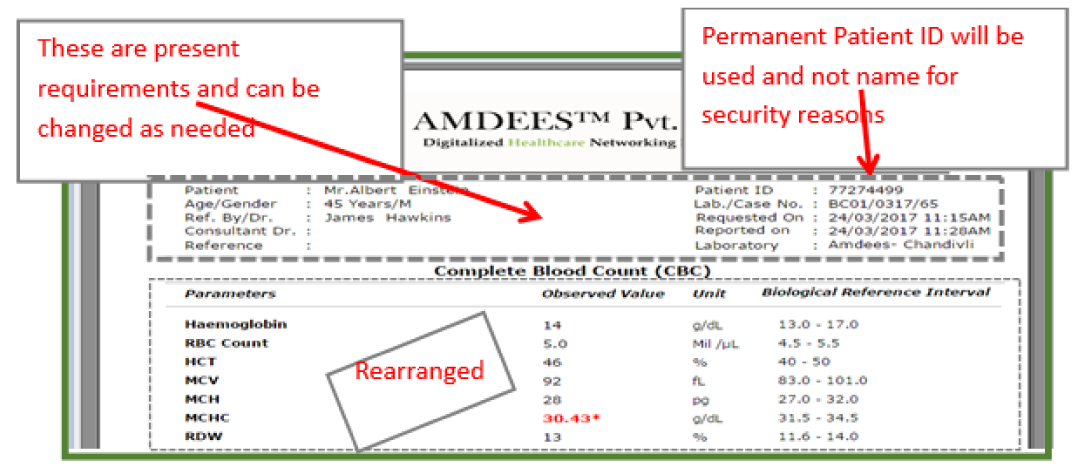
- All reporting formats across the industry has to be standard with précised information: Provider classification – Patient demography – Doctors area in separated sections – Doctor’s authorization, certification & contacts (please check supplement)
- Formats will accommodate all the EHR required data connectivity points
- Supply new formats to all certified Healthcare & Medical IT providers with ample time to overlapping old and software correction
Standard reporting implementation is the first area to focus that will solve the major hurdle and 50% job done for successful EHR
3. ONETIME New Patient Registration
- Standard registration form across the industry that will recognized the Patient with Unique Identification (UID) number or Aadhar Card
- Online availability for citizen, self-registration, correction etc.
- Patient Identifier Swipe Card
4. Software
- Core framework EHR application with needed norm, design & development using newer, extensible and scalable technologies
- Application will be connected to providers’ rest of the workflow software or can be separated
- Patients’ medical encountered data will be diverted to server (Government controlled) and stored for life that can be accessed by eligible entities with system provided authentication – no charge to all
- All healthcare applications has to freshly design that is compatible to EHR’s ‘plug and play’ rules – enrol healthcare IT supplier (open source software)
- Interoperability system development – There are existing HMS systems in big facilities can be challenged to changed instantly, eventually changing system is required with allotted timeframe
- All EHR necessary diagnostic data transferred by interface mechanism
- EHR application is no charge to all the provider, monthly service charges apply
5. Legal Healthcare licensing protocol for EHR use to eliminate illegal activities
6. All new facility licenses comes with EHR protocol
7. Patient portal facilitation: Website (extremely Mobile friendly) & Mobile App
8. Every healthcare facility needs to be standard equip, such as compatible computer(s), printer, barcode Machine, etiquette internet and swipe card for both Identification & Payment and more, whatever necessary
Regulations
We will incorporate regulation and guideline into project plan according to India’s geographical, cultural and constitutional required framework instead of fixing our system into European regulatory obligation. Regulations are tested example and great to have those successful theories on hand, we may avoid some and contribute few if necessary.
Road Ahead
EHR - ROADMAP is an elaboration of AMDEES’ tested minuscule experimented logic; this basic paper plan is a distance vision from reality that required detail attention.
Foundational blueprint required exceptional subject related intelligence of all possible aspect of the project that may include case study of small scale country’s EHR to gain additional intellect and to avoid missing links.
Assembling the project team, research, added subject collections for first phase blueprint needs substantial time & funds. Direct Government intervention is a must for GOAHEAD acknowledgement for the project to proceed further.
Others
- Internet/Satellite companies
- Hardware suppliers
- Medical fraternity opinion committee
- Multi Facility Hospital engagement
- State-run Hospital
- Rural research includes utility extensions
- Medical institutes EHR use programs
- Certified workforce supply
- Citizen involvement of self-care literacy
AMDEES’ Accomplishments
Pathology Project
Project Pathology was assisted by 4 pathologists, 2 microbiologists a Radiologist, and a Physician with their expertise, and also volunteers their Labs use for pilot operation for product testing.
Issues
Formats- Unstructured report templates without any system
- Personalized designed specific demands – CAPITAL, Bold, Underline, *#@, etc.
- Lab-to-Lab varied reporting methods - Gravimetric or SI units
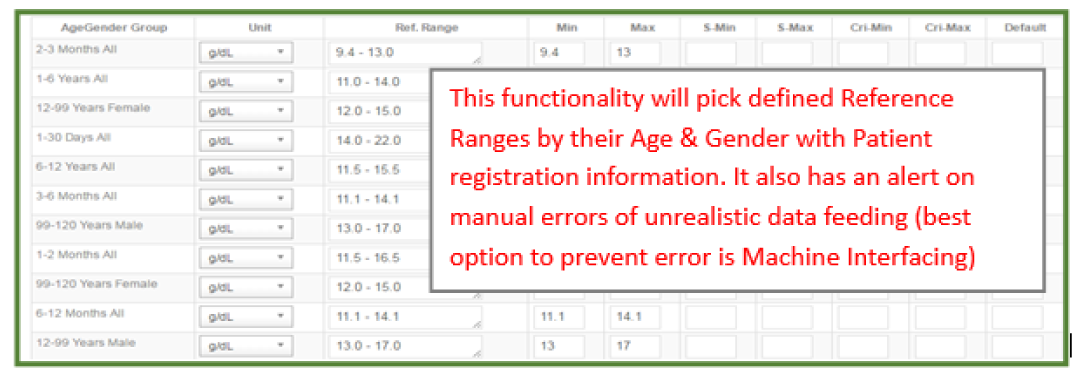
- One Reference Range for all (Gender & Age), a good amount of Labs
- Reference Ranges compatibility (Lab machine & reagent fixing)
- Insufficient Patient information capturing – Under trained and Lazy approach
- Lack of spelling literacy efficiency in employees – duplication
- Data feeding manual errors
- Sample mix-ups
- Obstacles in physical Reports delivery in emergencies
- Power interruption/ Internet speed or absence
Initial requirements
- Simple, restricted, and EHR compatible web-based application for systematic data accumulations-preservation and digital Reporting delivery/print
- Server and Data backup system
- Elimination of duplicity - to - Minimise manual errors with the technical mechanism
- Standardized formats with terminology that works for all
- Service-Base solution to control ongoing process of EHR prophecy (software-server-portal-training-updates-upgrades)
- Value-dded services to support digital Reporting concept – Users portal (Web-App) & notifications facilitations
- Incentive to Lab to roll in the programs
- Health & Healthcare literacy in citizens
- Follow the EHR standard guideline - Government of India
Pathology Concept Preparations
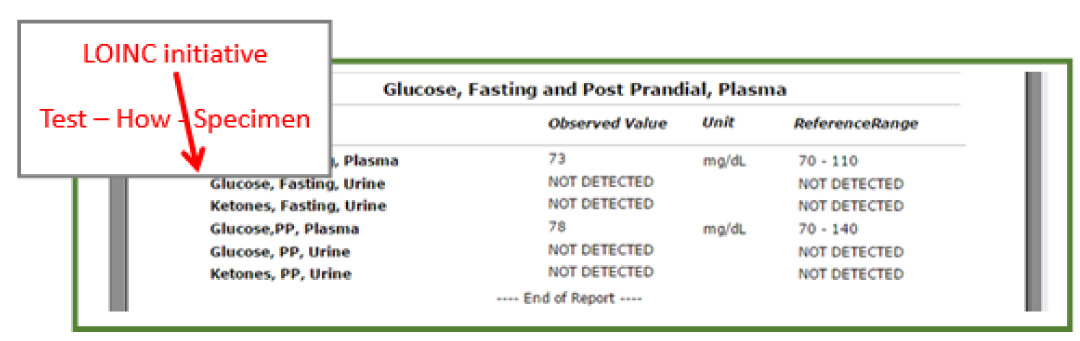
FormatsLogical Observation Information of Name and Codes (LOINC)
Tests Format Creation System©
There are 3,500 plus total Tests accumulated in the list including regular, specialized and international outsourcing.
Test formats creation system for uniformed Report appearance that is easy to read, and understand by all – This format is controlled by AMDEES and any new required Tests will go through our pathologist panel’s review for centralized acceptance with LOINC logic.
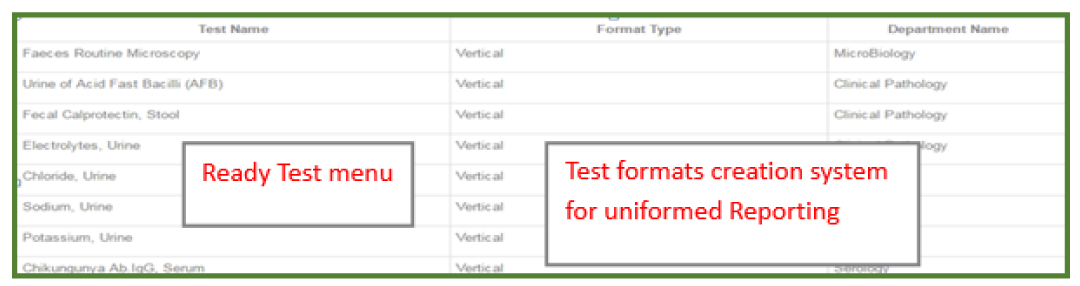
Patent India: An Electronic Modular and Customizable Pathology Test Form Creation System. Application No: 3126/MUM/2013 A – Innovator & Applicant: Mukesh Grami WIPO: WO/2015/049699 – An Electronic Modular and Customizable Pathology Test Form Creation System – PCT/IN2014/000635, Innovator & Applicant: Mukesh Grami
Centralized Services
- Web-Base Software, Maintenance, Upgrades, Updates & Support
- Server for Patient report delivery to all involved-authorized entities - view, print, and save.
- NABL equipped
- Machine Interfacing – No manual error
- Bar Coding – Eliminating sample mix-ups
- Notifications
Reference Ranges
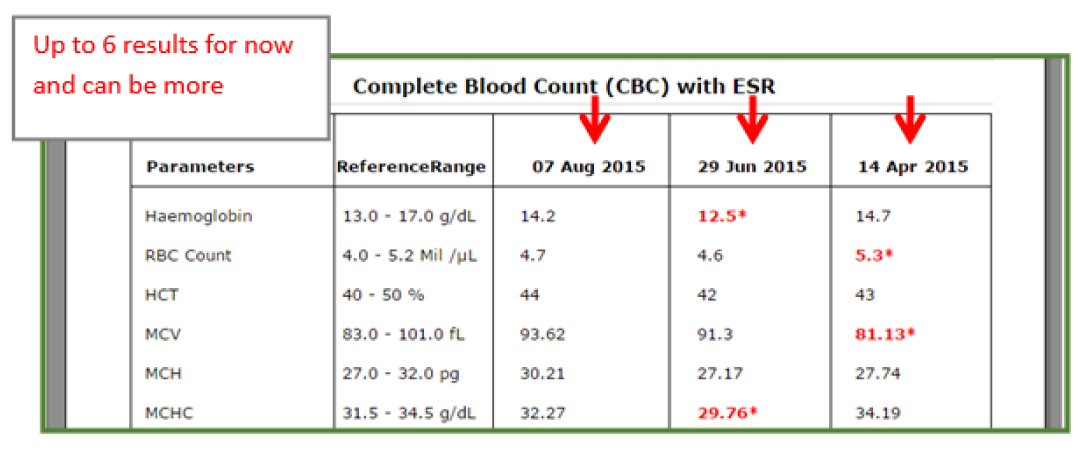
Test Comparisons Chart©
The most vital tool for a Patient’s chronic treatment and recovery assessment is periodic Tests done in case of Cancer, Type 2 Diabetes, Arthritis, Lipid, Thyroid, Obesity, etc., and also useful in preventive & pregnancy care. The digital layout will allow multiple test results of the same test on a single page for doctors and patients to recognize treatment outcomes at a glance.
All above formats fixation criteria are also very critical to make this chart possible somewhat, need legalized guidelines which is possible only with Health Ministry intervention.
Patent India: A Paperless Healthcare Ecosystem, Application No: 1506/MUM/2013 A, Publish Date: 17/4/2015, Name of Innovator & Applicant: Mukesh Grami
WIPO: WO/2014/178077 - PCT/IN2014/000263, Innovator & Applicant: Mukesh Grami
End-Users Facilitations
- Website & Mobile App (Identity) for Patient & Doctors, Reporting viewing and medical informatics
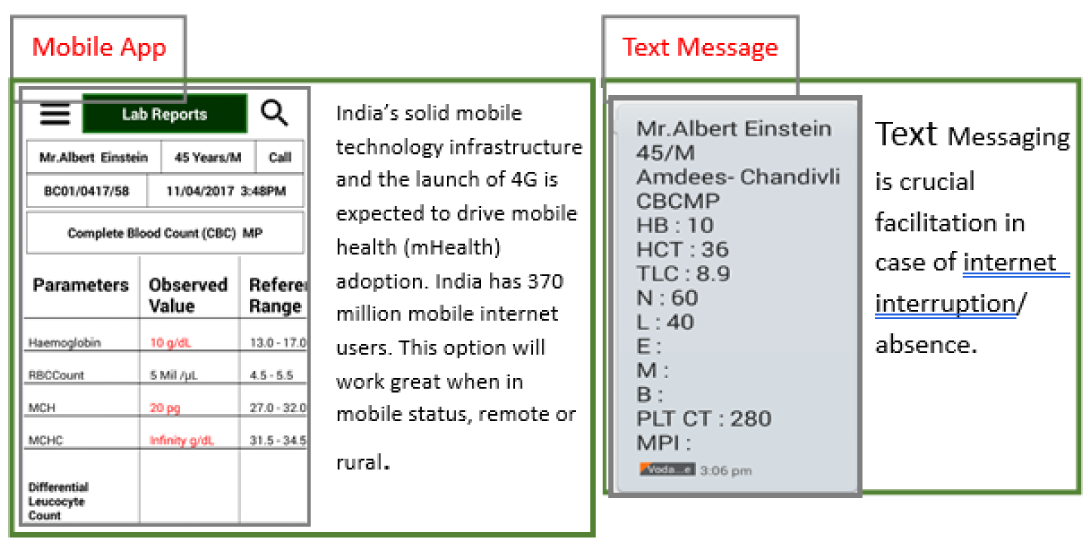
- Doctor notification – Precise parameters, useful Text message in the absence of internet
- Patient notifications – sample acceptance and Report ready
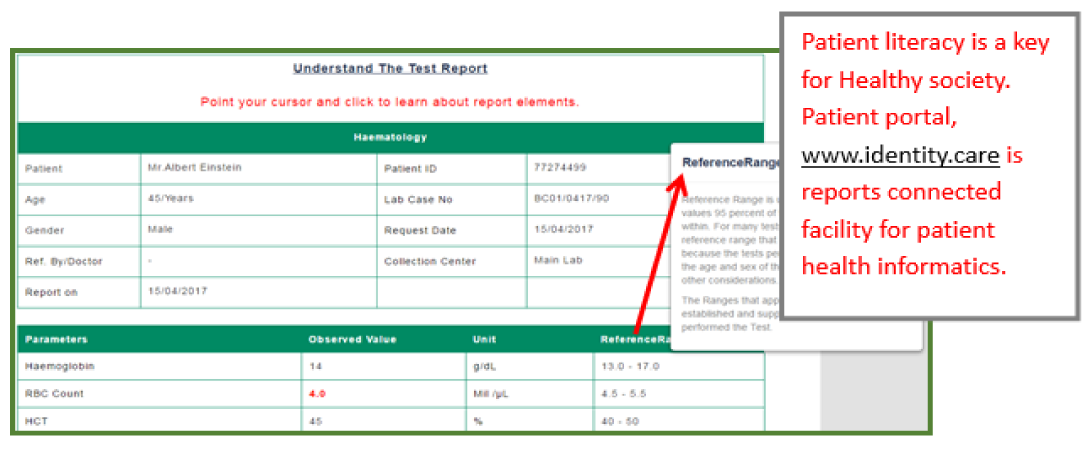
It helps all when Patient has a basic knowledge about their treatment and outcomes, viewing diagnostic Reports is nothing more than biological-chemical names & numbers.
Patient portal www.identity.care allows Patient to access their reports with the option of Understand Your Report.
The Patient is the ultimate end-user of the system, his/her medical literacy will help to boost EHR
Mobile Facilitation
Conclusion
In this presentation, we have discussed impractical medicinal workflow, divided healthcare, paralyzed infrastructure, unparalleled society, Government positive initiative, global EHR practice and their issues, case studies, and practical EHR achievable suggestions by experienced stakeholders.
Overall conclusion of this draft; we are better off building a new system instead of refurbishing scattered existence. The necessary steps we need to accomplish national scalable EHR, for citizens of India are:
Practical Roadmap – Quality Expertise – Strict Polices – Enthusiastic Team – Fund - Ethics
National Pride
- Healthy Society – Productive Nation
- Launching a project of this wide scope can be the trigger to launch India into a new era of innovation, it will considerably improve India’s image and soft power internationally
- Developing nations will be extremely grateful for such a gift from India and even developed ones may adopt the system if new technology fits to replace their old